Mawlamyine (Moulmein)
Mawlamyine (Moulmein)
Once Birmanie's first British capital, Mawlamyine blends pagodas commanding the Thanlwin, a red-brick colonial quarter and vibrant Mon culture — an essential stop in the country's south.
Mawlamyine — formerly Moulmein under British colonial rule — is the capital of Mon State, situated on the eastern bank of the Thanlwin River. The first major Burmese city under English administration, it preserves remarkable colonial architecture, pagodas arrayed along a ridge commanding the river, and a river-port atmosphere that Yangon lost long ago. Rudyard Kipling immortalized it in his poem Mandalay.
Key Practical Information
- Access from Yangon: overnight bus (approximately 6–7 hours) or train via Thaton; local airport with limited domestic flights.
- Recommended duration: 2 to 3 days for the city and immediate surroundings.
- Dress code: shoulders and knees covered when entering pagodas; bring easy-to-remove shoes.
- Currency: Burmese kyat; ATMs available downtown, but carry sufficient cash.
What to See
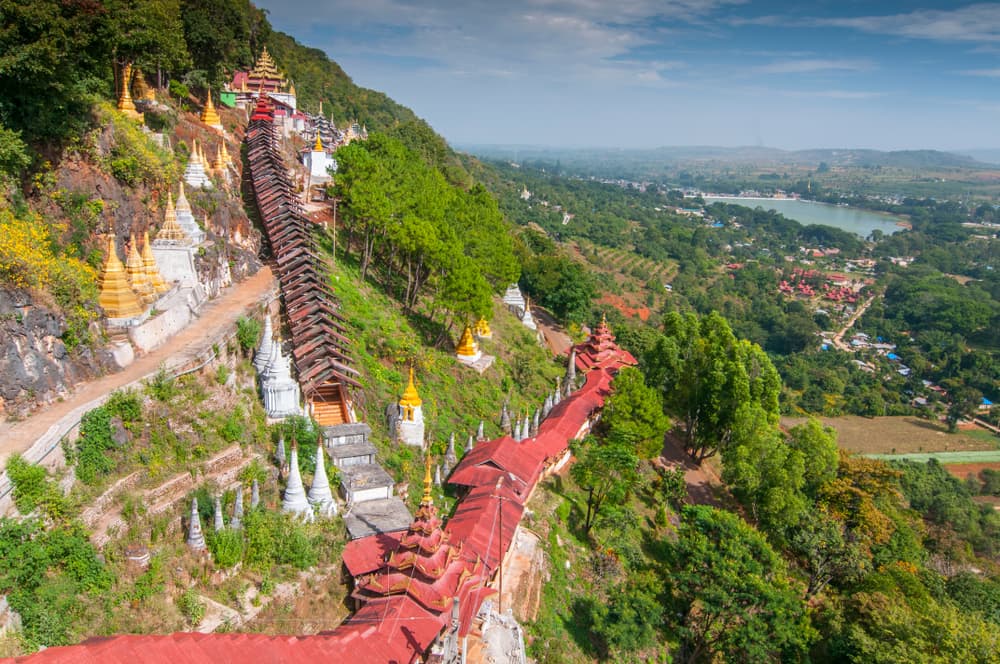
The Mawlamyine ridge concentrates several pagodas visible from the river. Kyaikthanlan Pagoda dominates the ensemble: its platform offers panoramic views over the Thanlwin, the islands, and on clear days, the Mon hills. Below, the city center reveals red-brick colonial buildings, lively markets, and an Indo-Burmese community inherited from maritime trade. The central market mingles Mon products, dried fish, and betel.
History and Context
Mawlamyine became the capital of British Birmanie in 1827, before that role passed to Yangon in 1852. This early status explains the density of its colonial heritage: courthouses, prison, All Saints Church still in use. The city is also a hub of Mon culture, one of Southeast Asia's oldest, predating the arrival of the Bamar.
Highlights of Your Visit
The Pagoda Ridge
A walk along the ridge connects several sanctuaries in succession. Uzina Pagoda and Win Sein Taw Ya Pagoda, with its immense reclining Buddha visible from the road south of town, complete the spiritual circuit. The atmosphere is contemplative, frequented mainly by local Mon pilgrims.
The Riverfront
The Thanlwin's edge comes alive in early morning: fishing boats, ferries to Martaban (Mottama) on the opposite bank, tea vendors. Here the city shows its most everyday face, far from tourist circuits.
The Colonial Quarter
A few streets around the former town hall and courthouse retain arcaded facades, wooden houses on stilts, and brick buildings characteristic of Indo-colonial architecture. Deterioration is advanced, but human scale remains intact.
Mon Cuisine
Mon gastronomy distinguishes itself from standard Burmese cooking: mohinga in its local version, milder curries, rice-based pastries. The tea-shops in the central market offer the best entry point.
Etiquette and Visit Guidelines
- Remove shoes and socks before entering any pagoda grounds.
- Dress modestly: a sarong or longyi is appreciated; wraps are sometimes provided at entrances.
- Avoid pointing your feet toward Buddha statues or monks.
- Ask permission before photographing people in prayer.
Photography Tips
Golden late-afternoon light on the ridge is ideal for photographing pagodas with the river as backdrop. Sunrise from Kyaikthanlan's platform offers a clear eastward view. In the colonial quarter, raking morning light reveals the texture of brick facades. Avoid midday, which creates harsh contrast.
Location and Access
Mawlamyine lies approximately 300 km southeast of Yangon, at the edge of the Thanlwin delta. Overnight bus from Yangon remains the most common option. Tuk-tuks and motorbike taxis handle local transport. The city is flat and partly navigable by bicycle, available for rent near the market. Accessibility for people with reduced mobility is limited in pagodas due to stairs.
Nearby destinations to combine: Golden Rock (Kyaiktiyo), reachable in a few hours to the north, and Mon villages in the region.
Nearby Attractions
- Golden Rock (Kyaiktiyo) — one of the country's most venerated pilgrimage sites, a few hours' drive north.
- Hpa-an — capital of Karen State, surrounded by limestone karsts, Buddhist caves and rice fields; approximately 2 hours by boat or bus.
- Bago — former royal capital with pagodas and reclining Buddha, on the road to Yangon.
Frequently asked questions
The dry season, November to February, offers the most pleasant conditions: moderate heat and clear skies. Avoid the monsoon (June–October), which makes some roads difficult to access.
Yes, this is a classic itinerary. From Yangon, head north to the Golden Rock, then descend toward Mawlamyine before continuing to Hpa-an. Allow a minimum of 5 to 6 days for this triangle.
Yes: shoulders and knees covered, shoes removed at the entrance to each compound. A lightweight longyi or sarong is suitable and easily found in local markets.
Mawlamyine is accessible for self-guided exploration: varied accommodations, local transport available, and main sites can be visited without a guide. A few words of Burmese or Mon ease interactions outside tourist areas.
A boat service on the Thanlwin connects the two cities; the crossing is slower than the bus but offers a unique perspective on river landscapes. Check availability on site, as schedules vary by season.
Two days suffice for the pagoda ridge, riverfront, and colonial quarter. Add a day if you wish to explore surrounding Mon villages or the reclining Buddha at Win Sein Taw Ya.
Want to discover this destination?
Our local advisors design your tailor-made trip.