Colonial Quarter of Yangon (Downtown Yangon)
Colonial Quarter of Yangon (Downtown Yangon)
At the heart of Yangon, the Colonial Quarter brings together one of Southeast Asia's largest concentrations of British architecture: pagodas, Art Deco facades and street markets to explore on foot.
At the heart of Yangon, the Colonial Quarter concentrates one of Southeast Asia's best-preserved ensembles of British architecture. Between the Yangon River and Sule Pagoda, hundreds of buildings erected between 1850 and 1940 sit alongside pagodas, markets and bustling streets. This downtown tells both the story of Birmanie's colonial capital and the daily life of a metropolis in full transformation.
Practical Information at a Glance
- Access: Sule Pagoda Road is the central landmark; accessible by taxi, bus or on foot from Yangon Central Railway Station.
- Suggested duration: Allow half a day for a walking exploration of the main streets, a full day to enter buildings open to the public.
- Dress code: No restrictions in the streets; covered clothing and bare feet required if you enter the quarter's pagodas.
- Accessibility: Uneven sidewalks and numerous steps; wheelchair access difficult.
What to See
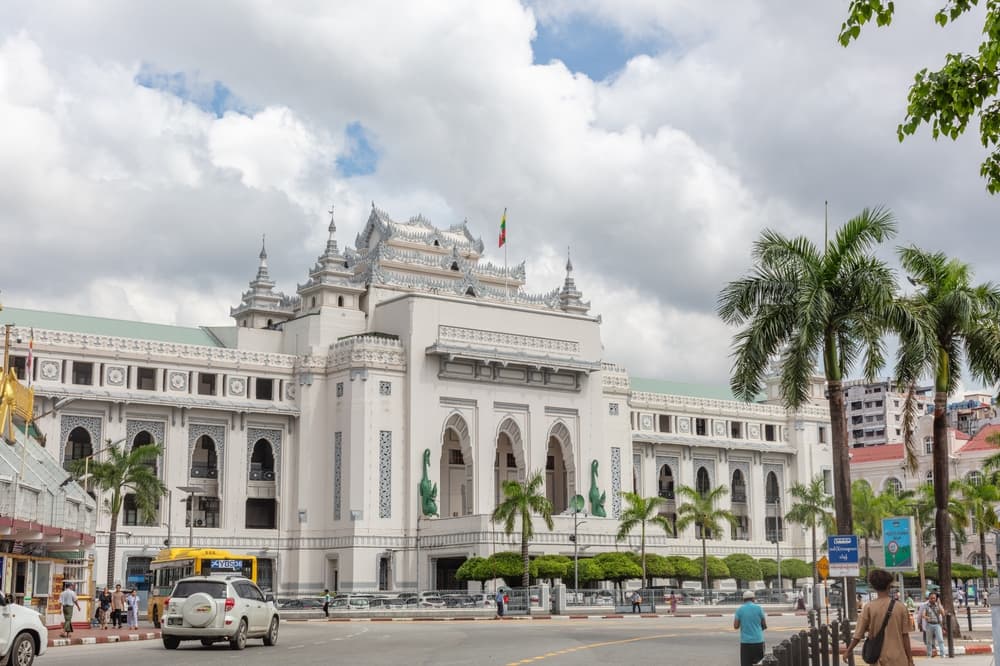
The quarter is lined with neoclassical, Indo-Saracenic and Art Deco facades, often draped in tropical vegetation. Among the most remarkable buildings: the former Secretariat (brick building where Aung San was assassinated in 1947), the Supreme Court, City Hall, Central Railway Station and the Strand Hotel. Market streets such as Pansodan Street or Merchant Street blend sidewalk bookstalls, tea shops and money exchanges.
History and Context
Yangon became the capital of British Birmanie in 1852 following the Second Anglo-Burmese War. The British laid out a grid pattern south of Sule Pagoda and erected the Empire's institutions there: courts, banks, hotels, port warehouses. The city was then called Rangoon. After independence in 1948, and the relocation of the capital to Naypyidaw in 2006, the historic center froze in relative neglect which, paradoxically, preserved its urban fabric.
Highlights of the Visit
The Former Secretariat
This complex of red brick in Neo-Gothic and Indo-Saracenic style occupies an entire city block. This is where Aung San and his ministers were assassinated on July 19, 1947. The building, long closed, has partially reopened to the public in recent years as part of a rehabilitation project.
Sule Pagoda
Planted at the center of a roundabout, this octagonal golden pagoda is said to date back over 2,000 years according to tradition. It serves as the zero point for the colonial grid plan and remains an active place of worship, frequented at all hours by residents.
Strand Hotel and the Waterfront
The Strand Hotel, opened in 1901, embodies the colonial golden age. Its veranda and bar are accessible to non-residents. Nearby, Strand Road runs along the Yangon River with views of ferries and barges connecting both banks.
Pansodan Street and Street Culture
This thoroughfare concentrates booksellers, newspaper vendors and small lunch restaurants. On weekends, artists display their canvases on the sidewalk, making Pansodan an informal open-air gallery.
Photography Tips
The golden morning light (before 9 a.m.) is ideal for photographing facades without backlighting or crowds. Side streets perpendicular to Merchant Street offer framing with vegetation and architectural details. Avoid flash inside pagodas and always ask permission before photographing people.
Location and Access
The Colonial Quarter occupies the southern tip of Yangon, bounded by the river to the south and west, and by Anawrahta Road to the north. Yangon Central Railway Station is located at the northern edge of the area. Taxis and tuk-tuks are plentiful; several bus lines serve Sule Pagoda Road. The quarter is best explored on foot: distances between major buildings are short.
Nearby Attractions
- Shwedagon Pagoda — Yangon's great golden pagoda, a few kilometers north, is the country's most venerated Buddhist site.
- Bogyoke Aung San Market — Large covered market with colonial architecture, ideal for Burmese crafts, gemstones and textiles.
- Kandawgyi Lake — Artificial lake surrounded by gardens, offering a natural counterpoint to downtown concrete.
- Botahtaung Pagoda — Riverside pagoda, rebuilt after World War II, with a hollow interior that visitors can walk through.
Frequently asked questions
The dry season, from November to February, offers milder temperatures and clear skies, ideal for walking for several hours. Avoid midday during hot season (March-May) when temperatures exceed 35°C.
In the streets, no restrictions. If you enter Sule Pagoda or Botahtaung Pagoda, plan clothing covering shoulders and knees, and remove your shoes at the entrance.
Yes, this is the most common combination. Spend the morning in the Colonial Quarter, then head to Shwedagon in late afternoon to enjoy the golden light at sunset.
The building has partially reopened as part of a rehabilitation project. Access conditions may vary; check with your local agency before your visit.
Sidewalks are often damaged, raised or obstructed. Wheelchair access is difficult; a companion is strongly recommended.
Several local agencies offer thematic walking tours (architecture, history, street food). These tours allow access to courtyards and buildings normally closed to unaccompanied public visitors.
Interested in this visit?
We can include it in your personalised itinerary.