Thatbyinnyu Temple
Thatbyinnyu Temple
Thatbyinnyu is Bagan's tallest temple, rising 61 meters above the plain and built in the 12th century under King Alaungsithu. A Buddhist sanctuary at the heart of the archaeological zone, it pairs naturally with a visit to the nearby Ananda Temple.
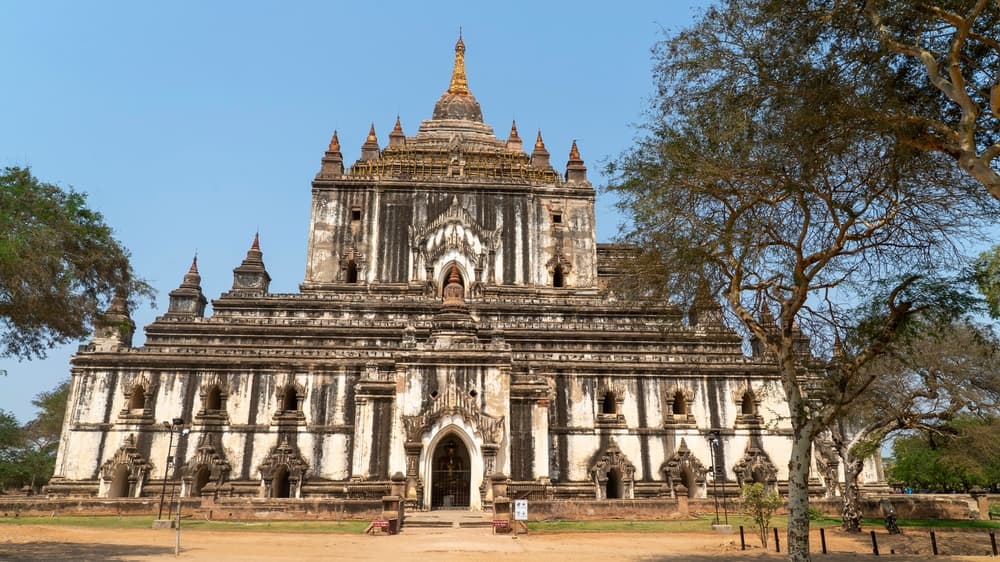
Thatbyinnyu is the tallest temple in Bagan, rising approximately 61 meters above the plain. Built in the 12th century under the reign of King Alaungsithu, it embodies classical Burmese architectural style: twin superimposed towers, vaulted galleries, and a silhouette that dominates the horizon from almost any point in the archaeological zone. Its name means "omniscience" in Pali, reflecting its dedication to the Buddha.
Practical Information at a Glance
- Access: included in the Bagan archaeological zone entrance ticket (paid at the entrance)
- Dress code: shoulders and knees must be covered; shoes must be removed before entering
- Recommended duration: 30 to 45 minutes on site
- Interior access: upper levels have been closed to visitors since the 2016 earthquake; only the lower level is accessible
- Transport: bicycle, e-bike, or horse cart from Nyaung-U or Old Bagan; the temple is visible from afar and easy to spot
What You'll See
The structure consists of two massive stacked cubes, each topped with a terrace, crowned by an elongated spire (sikhara). The exterior walls are punctuated with shuttered stone windows and niches housing Buddhist figures. Inside the accessible level, a large seated Buddha statue occupies the main sanctuary, surrounded by partially preserved murals.
History and Context
Thatbyinnyu is attributed to King Alaungsithu (reigned circa 1113–1167), one of the great builders of the Pagan dynasty. Its double-story design marked an evolution from the single-level temples that preceded it. It served both as a place of worship and as a symbol of royal power. The August 2016 earthquake damaged several structural elements, leading to the closure of the upper levels for safety reasons.
Highlights of Your Visit
The silhouette from the outside
The east and west façades offer the clearest view of the architectural composition. From the main road, the tower stands out sharply against the sky, especially in late afternoon when raking light accentuates the relief of the mouldings.
The inner sanctuary
The vaulted corridor leading to the main Buddha creates a striking sense of depth. Fresco fragments on the side walls testify to an originally elaborate decorative programme, now partially erased by time and humidity.
The view over the plain
Even from ground level, Thatbyinnyu serves as a visual landmark for understanding Bagan's spatial layout. It sits in immediate proximity to Ananda, allowing you to take in two of the zone's major monuments at a glance.
Etiquette and Visiting Rules
- Remove your shoes and socks before entering the sacred precinct.
- Cover shoulders and knees; sarongs can be borrowed at the entrance to nearby temples.
- Speak in a low voice inside the sanctuary.
- Do not touch the statues or murals.
- Upper levels are off-limits: respect the barriers in place.
Photography Tips
Morning light (before 9 a.m.) illuminates the east façade and imparts warm tones to the ochre stone. In late afternoon, the west façade is ideal. To frame the entire tower, step back to the main road: the temple is so tall that a wide-angle lens is necessary when shooting close. Inside, natural light filtered through the shuttered windows creates interesting shadow play on the Buddha—a lightweight tripod can be helpful.
Location and Access
Thatbyinnyu is located in central Bagan, a few hundred meters southwest of the Ananda Temple. It is accessible from Nyaung-U by e-bike (about 20 minutes) or by horse cart. The main road running alongside the temple is suitable for bicycles. The ground around the monument is dirt, not wheelchair-friendly.
Nearby
- Ananda Temple — Bagan's best-preserved temple, a short walk away, featuring four monumental standing Buddhas.
- Dhammayangyi Temple — Bagan's most massive structure, renowned for its precision masonry and partially walled corridors.
- Sulamani Temple — a two-story 12th-century temple, celebrated for its murals and refined architecture.
- Shwesandaw Pagoda — tiered terraces offering panoramic views of the Bagan plain, particularly popular at sunset.
Frequently asked questions
No. Since the August 2016 earthquake, the upper levels have been closed for safety reasons. Only the lower level with the main sanctuary remains accessible to visitors.
No. The temple is included in the general entrance ticket to the Bagan archaeological zone, available at one of the checkpoints at the zone's entrance.
Shoulders and knees must be covered. Shoes and socks must be removed before entering the precinct.
Yes, the two temples are very close to each other. Most visitors tour them back-to-back on foot or by bicycle in the same half-day.
The dry season (November to February) offers comfortable temperatures and clear skies. Avoid the rainy season (June–October) if you want to cycle easily between temples.
Photography is generally permitted in areas open to visitors. Avoid using flash near murals and do not climb on structures to take photos.
Interested in this visit?
We can include it in your personalised itinerary.