Shwesandaw Pagoda
Shwesandaw Pagoda
Built in the 11th century by King Anawrahta, Shwesandaw Pagoda offers from its five terraces a unique panorama over the Bagan plain and its thousands of temples.
Shwesandaw Pagoda rises at the heart of the Bagan plain in central Birmanie. Constructed in the 11th century under King Anawrahta, this cylindrical stupa with five terraces is one of the oldest on the site. It is best known for offering a 360° panorama over the thousands of temples that dot the plain — a vantage point that travelers particularly seek out at sunrise and sunset.
Practical information at a glance
- Entry: included in the Bagan archaeological pass (paid, purchased at the zone entrance)
- Dress code: shoulders and knees must be covered; shoes to be removed before climbing
- Recommended duration: 30 to 60 minutes, longer if you wait for sunset or sunrise
- Access: by bike, e-bike or horse cart from Nyaung-U or Old Bagan
- Accessibility: terraces accessible only by steep stairs; limited access for people with reduced mobility
What to see
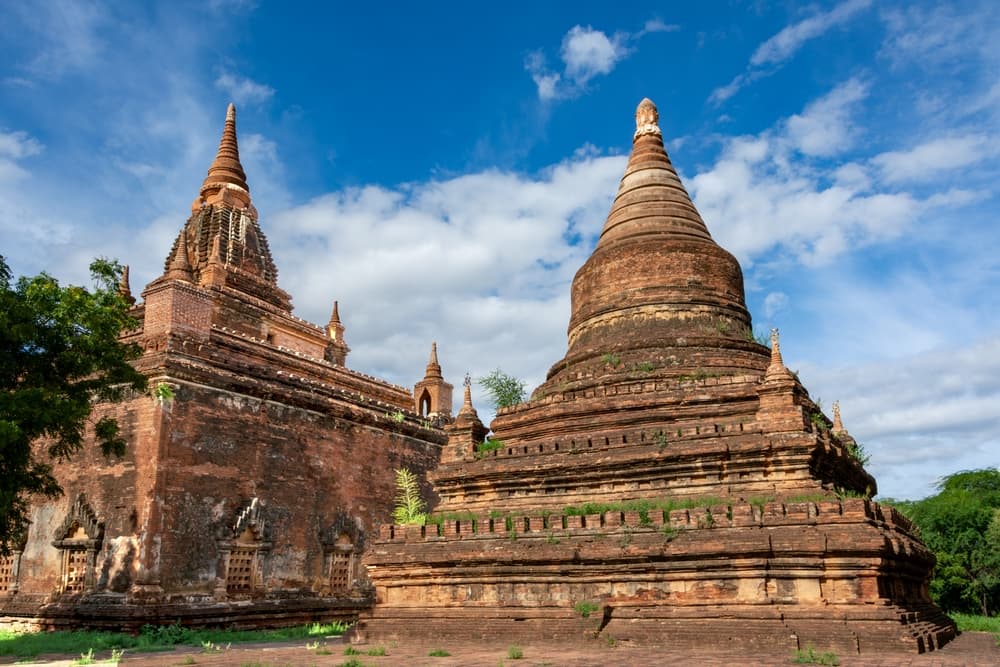
The main stupa is cylindrical in shape, topped with a hti (golden parasol). Five successive terraces allow you to climb gradually. From the summit, the view embraces the entire plain: red-brick temples, dry vegetation, the Irrawaddy River winding at the horizon. At dawn, the morning mist envelops the monuments in particularly striking golden light.
History and context
Anawrahta, Birmanie's first unifying king, had Shwesandaw erected in 1057 following his victory over the Mon kingdom of Thaton. The pagoda is said to have housed relics of Buddha's hair, hence its name — shwe (gold), san (hair), daw (royal). It marks the beginning of the great building period of Bagan, which saw the rise of more than 10,000 monuments between the 11th and 13th centuries.
Highlights of your visit
The panorama at sunset
The five terraces offer complete unobstructed views over the plain. Sunset tints the bricks in ochre and red. Arrive at least 45 minutes early to find a spot on the upper terraces, which are very crowded during high season.
The central stupa
The cylindrical silhouette, distinct from Bagan's conical spire temples, reflects Mon architectural influence. The golden hti at the summit is visible from far across the plain.
The atmosphere at sunrise
Less crowded than sunset, sunrise from Shwesandaw reveals the mist over the plain and hot air balloons launching at dawn — a silent and memorable spectacle.
Etiquette and visiting rules
- Remove shoes and socks before climbing the terraces.
- Shoulders and knees covered for both men and women.
- Respectful behavior: the pagoda remains an active place of worship.
- Avoid sitting with your back to the stupa when taking photos.
Photography tips
Light is optimal in the hour following sunrise and in the 30 minutes before sunset. A wide-angle lens captures the plain in its entirety from the upper terrace. Hot air balloons at sunrise are a highly sought-after subject — bring a telephoto lens. Climbing the terraces also offers interesting angles on the stupa itself shot from below.
Location and access
Shwesandaw is located in the central zone of the Bagan archaeological plain, between Old Bagan and New Bagan. It is easily accessible by bike or e-bike from Nyaung-U or Old Bagan. Horse carts offered at hotel entrances provide a comfortable alternative. The laterite track running along the pagoda is passable year-round. No direct public transport serves the site.
Nearby
- Ananda Temple — masterpiece of 11th-century Mon architecture, a few kilometers to the north.
- Thatbyinnyu Temple — Bagan's tallest temple, visible from Shwesandaw's terraces.
- Dhammayangyi Temple — the most massive temple on the plain, in immediate proximity to the southeast.
- Sulamani Temple — two-level architecture adorned with finely carved stucco.
- Bagan Archaeological Museum — collections of sculptures and objects discovered on the site.
Frequently asked questions
No. Entry is covered by the Bagan archaeological pass, valid for all monuments in the zone. This pass is mandatory to access the site.
The dry season, from October to February, offers the most pleasant conditions: clear skies, moderate temperatures. The monsoon (June-September) makes tracks muddy but vegetation is greener and crowds smaller.
Yes, the terraces remain accessible to visitors. Following the 2016 earthquake, some Bagan temples were partially closed, but Shwesandaw remains open for climbing. Check local conditions upon arrival.
Sunset attracts more crowds. Sunrise offers a quieter atmosphere, with morning mist and hot air balloons at takeoff. If you wish to avoid crowds, opt for dawn.
On an e-bike or regular bike, one day is enough to visit Shwesandaw, the nearby Dhammayangyi Temple and Sulamani Temple. Plan the morning for interiors (diffuse light, less heat) and Shwesandaw late afternoon for sunset.
Photography is allowed on the terraces and around the stupa. Inside sanctuaries, some spaces may restrict photos of sacred statues — respect any signs posted on site.
Interested in this visit?
We can include it in your personalised itinerary.