Kuthodaw Pagoda
Kuthodaw Pagoda
At the foot of Mandalay Hill, Kuthodaw Pagoda houses 729 marble slabs inscribed with the complete Theravada Buddhist canon—an active pilgrimage site and a masterpiece of 19th-century Burmese royal architecture.
At the foot of Mandalay Hill, Kuthodaw Pagoda contains what is often called the world's largest book: 729 white marble slabs inscribed with the complete Theravada Buddhist canon. Built during the reign of King Mindon in 1857, it stands as an active pilgrimage site and an architectural testament to Burmese royalty at its height.
Practical Information at a Glance
- Entrance: paid admission for foreign visitors (ticket included in Mandalay sites pass)
- Dress code: shoulders and knees must be covered; shoes must be removed before entering the compound
- Recommended duration: 45 minutes to 1.5 hours depending on your interest in the inscriptions
- Access: on foot from Mandalay Hill, by taxi or bicycle—the pagoda is located at the southeast base of the hill
What to See
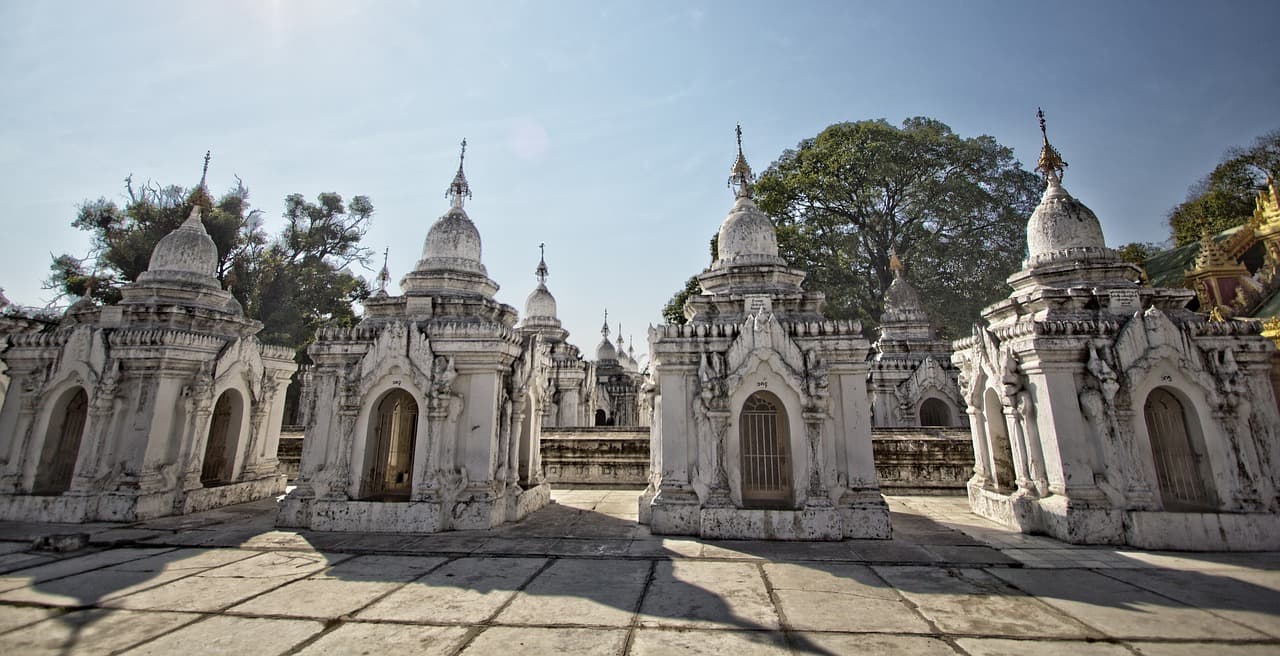
The golden central stupa, the Maha Lawka Marazein, rises at the heart of a vast white compound. Surrounding it are 729 small white pavilions (kyauksa gu), each housing a marble slab inscribed on both sides. Together, they reproduce the entire Tipitaka, the Pali canon of Theravada Buddhism. The immaculate whiteness of the aligned pavilions creates a rare atmosphere of contemplation.
History and Context
King Mindon commissioned Kuthodaw in 1857, shortly after founding Mandalay as the new royal capital. In 1871, he convened the Fifth Buddhist Council to revise and establish the text of the Tipitaka. Two thousand four hundred monks participated in the review. The result was inscribed on the 729 slabs, a project that took several years. The site is registered as part of Burma's national heritage.
Highlights of Your Visit
The 729 Marble Slabs
Each slab measures approximately 1.07 m wide and 1.53 m high. The Pali text is inscribed in Burmese characters on both faces. Even without reading Burmese, the density and precision of the carving are striking. Some pavilions remain open, allowing you to approach the slabs closely.
The Central Stupa
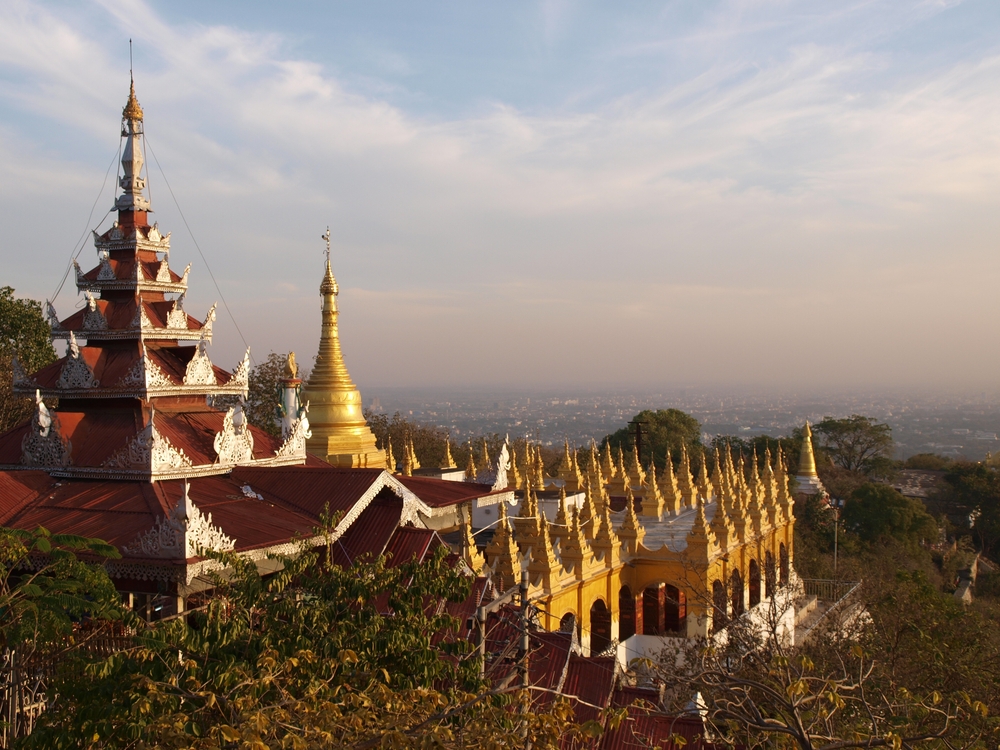
The Maha Lawka Marazein follows the design of the Shwezigon Pagoda in Bagan. Its golden spire is visible from several points across the city. In late afternoon, the raking light brings out the golden reliefs against an orange sky.
The Pilgrimage Atmosphere
Kuthodaw remains a living place of worship. Monks study here, Burmese families come to pray. Witnessing this spiritual daily life—quiet and genuine—is often what visitors remember most.
Etiquette and Visiting Rules
- Remove your shoes and socks upon entering the compound.
- Dress modestly: shoulders and knees must be covered.
- Speak softly in areas of prayer and meditation.
- Do not touch the marble slabs.
- Avoid turning your back to the central stupa when taking photographs.
Photography Tips
Morning light (before 9 a.m.) bathes the white pavilions in a soft golden hue, free of the harsh shadows of midday. In late afternoon, the central stupa captures the warm light of sunset. The aligned pavilion walkways offer strong geometric perspectives: frame from a slight overhead angle from one of the side aisles. Photography is permitted within the general compound; remain discreet near prayer areas.
Location and Access
Kuthodaw is located at the southeast foot of Mandalay Hill, in the northern part of the city. It is easily accessible by bicycle from the city center, by taxi or motorbike taxi. The pagoda is often visited in combination with a climb up Mandalay Hill and the nearby Sandamuni Pagoda. The site is accessible on foot from the base of the hill in a few minutes.
Nearby Attractions
- Mandalay Hill — the climb offers a panorama of the entire Mandalay plain and the royal palace.
- Sandamuni Pagoda — an immediate neighbor to Kuthodaw, it also houses hundreds of inscribed marble slabs.
- Mandalay Royal Palace — the former residence of King Mindon, surrounded by a moat, a few kilometers south.
- Shwenandaw Monastery — a remarkable example of Burmese woodcarving, a stone's throw from the hill.
Photos
Interested in this visit?
We can include it in your personalised itinerary.